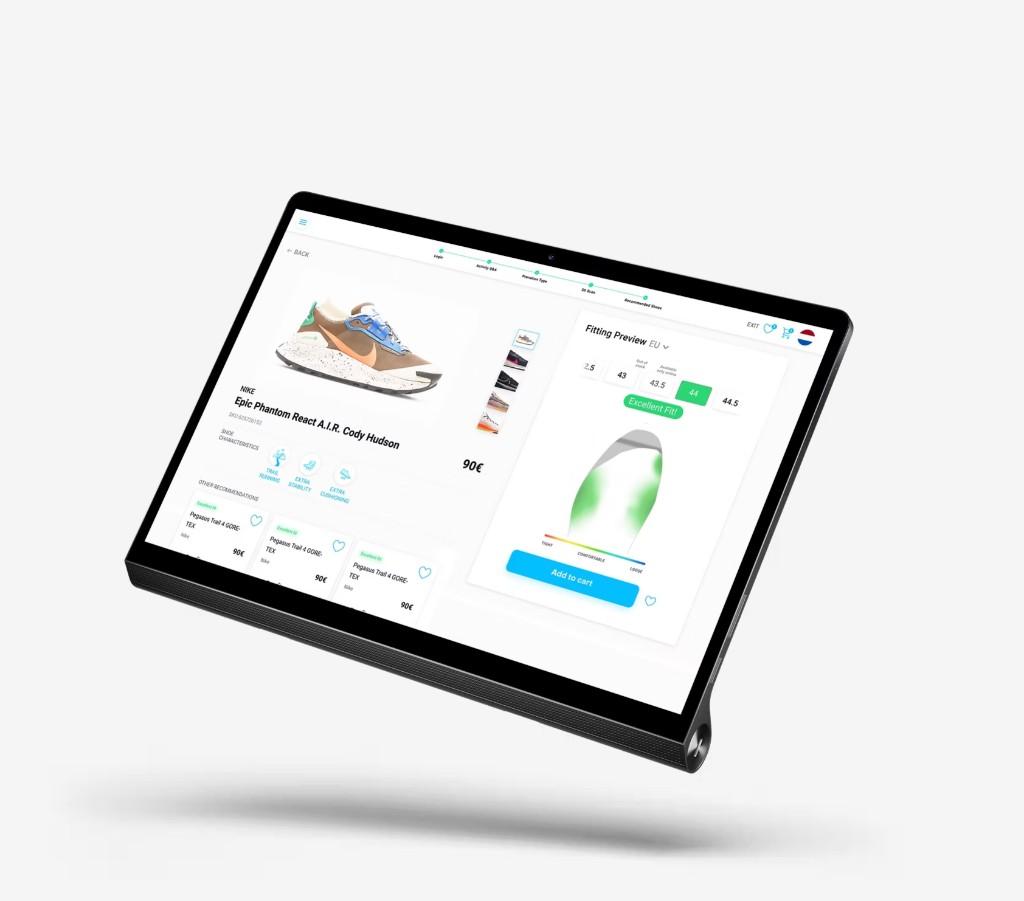

01Knowing your size, with nowhere to go
SafeSize scans your foot in a shop and tells you which shoe will actually fit. The scanner already worked, and it was already out in the world, on screens inside big shops like Nike and Intersport. What the app couldn't do was let you act on the answer. You learned your size and then had nowhere to go with it. No cart, no checkout, no path from knowing to buying.
I came in through Code.Hub as an outside consultant, for three months, to design that missing piece: the flow that turns a fitting tool into something you can buy from.
SafeSize already had a senior designer in-house. She stayed on the product as a stakeholder while I led this phase, and we agreed early on how we'd work together. It was a good collaboration, which you can't count on when you parachute into someone else's product.
02The scope nobody drew
The brief sounded small: add a buy flow. The real work was somewhere else.
SafeSize was an established product, with an experience that had been settling for a long time before I arrived. A buy flow dropped into the middle of it was never going to slot in cleanly. It would touch existing flows, existing screens, existing patterns, and the job was to add all of it without disturbing what already worked.
None of that was defined in the first meeting. How big the change was only showed once I started studying the product and tracing where the new feature would land. So before I designed anything, the real first job was mapping everything the change would touch, because nobody had.
03Learning a product that wasn't mine
Three months isn't long to understand a product you didn't build. So I spent the early part on the unglamorous work. Desk research. A look at how other shops online handle the parts I had to design: adding to the cart, the checkout, the moment you decide to buy. An audit of SafeSize's app, flow by flow. And under all of it, learning their design system: how it was built, what the brand guidelines said, how the pieces were meant to fit.
The audit turned up more than the missing checkout. Some things in the existing product were a little off, and I said so. Part of what I handed back was a set of notes on what was worth changing, some to make room for buying, some to prepare for flows they hadn't built yet.
If you audit a product properly, you find things. The value is in telling them.
04Two flows, and the developers first
I designed two options for the buy flow, and I didn't take either of them to the stakeholders first. They went to the developers, the technical team, the business analysts and the project owners, so we could agree on what could actually be built before anyone spent a meeting reacting to a picture. What the systems could return, what was possible, what would break if we did it one way. That conversation happened first.
Both flows covered every state: the path where everything goes right, and the one where it doesn't, the errors and the edge cases. So everyone agreed on how it behaved when things went wrong, not only when they went well.
Then the two options went to the stakeholders. We talked, they left comments in the files, and we chose the direction together. With the flow agreed, I extended their design system to carry it and built the components the new screens needed. I was adding to their system, not replacing it.
05The part that stays after I leave
Because I had to learn their system from the outside, I also had to write down what I learned. The documentation had gaps, so I wrote guidelines as I went: how the colours were meant to be used, how the buttons worked, how the new components sat next to the old ones. By the end, I didn't only hand over a flow. I handed over a written way to extend it.
I've watched this repeat on most projects I've worked on. Documentation is the thing designers skip, especially when we work alone, because the whole system already sits in our heads and writing it down feels like the least urgent thing on the list. It's also the thing that quietly saves you. Without it, you loop: you rebuild the same reasoning twice and rediscover a decision you already made. With it, the next person, or the next version of you, doesn't start from nothing.
Here it paid off straight away. I delivered the flows, and the developers built the whole thing over the following month, a sprint or two behind me while I stayed ahead. The handoff was fast, partly because I'd worked with these developers before, and partly because the decisions were already written down. Nothing had to be explained twice.
06The work
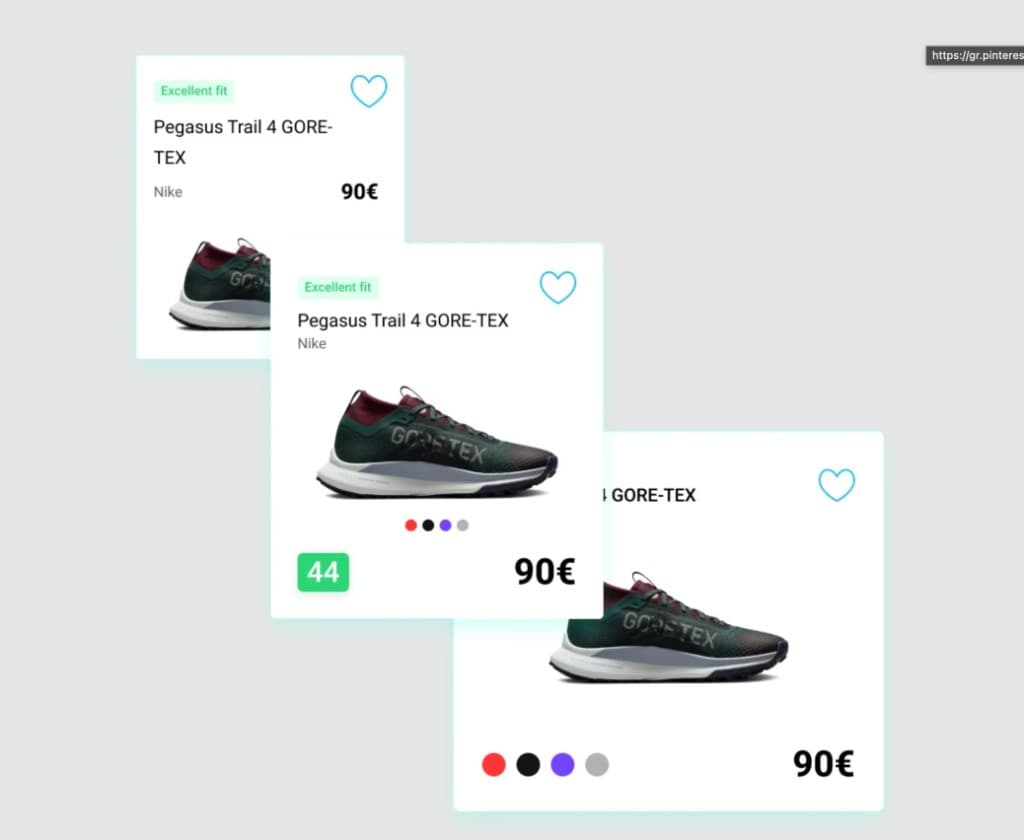
More of SafeSize, shown large: the shoe cards, in three sizes.
07What I'd do first next time
Three months to understand a product I hadn't built, its flows, its look, its history, and then to add new flows inside it without damaging an experience that took years to settle. That's a real skill, and it's a different one from starting a product on a blank page.
If I did it again, I'd change the order. I found the true scope, which existing flows the buy flow would touch, in the middle of the project. I should have found it at the start. I'd study the whole product first, map every place the change would reach, and only then design the buying on top of it.
Understand it all first and you buy back time for everything after. That, and the documentation, are the two things I took from SafeSize, and they're the two things I now do first.